

Governor: Two “May Revise” Budgets Coming Thursday
Governor Schwarzenegger said Monday morning that he will release two revised budget proposals on Thursday to show voters the budget options, depending on whether the May 19 Special Election measures pass or fail.
The governor said one revised budget proposal would show the state spending plan in the event that all six measures pass; the other would show precisely what cuts he will propose if all the measures fail.
He said he was doing this “so that people have a clear understanding” of the situation. Schwarzenegger made this announcement after a meeting with local government officials from around Southern California at the Culver City Senior Center.
UPDATE — Governor’s office clarifies: The official May revise release is May 28. But they are going to release two "summaries" — one if the measures pass, one if they fail — on Thursday.
How to blow up a spending limit
While attacking the spending limit for being too weak, “Anti-Tax Advocates” seem to have created their own confusion over spending limits. After weeks of denigrating Proposition 1A, even though it uses the venerable Gann Limit factors (population plus CPI) to limit revenue growth to control the revenues from the rainy day fund when needed, the advocates have suddenly scrambled to concoct an alternative to the so-called hard cap of population and CPI growth.
As stated in these pages last week, and reported again over the weekend, anti-tax advocates would prefer to limit spending not based on the Gann factors, but based on GDP growth. But, as the chart below shows, after 20 years spending under such a plan, the limit would have been $13 billion HIGHER than under the Gann Limit. No wonder the public employee unions have joined forces with them to oppose Proposition 1A.
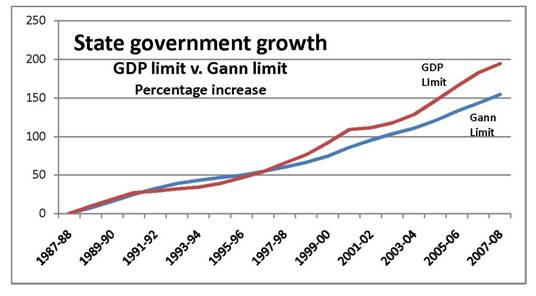 State Government Growth: GDP Limit vs Gann Limit
Let’s Get the Election Over With So The Real Campaign Can Begin
Most of the time, Yogi Berra is right. It’s not over ‘til it’s over. But when it comes to the May 19 special election in California, folks are behaving like it’s over.
The election campaign has been a small, relatively cheap one. The back-and-forth charges have been fairly civil. Given the condition of the state, one would expect a heated campaign. But the only real heat is being generated by fighting over what happens after the election. Schwarzenegger, Democratic legislative leaders, and their allies are predicting that their opponents, by defeating the special election measures, will be pushing the state over the cliff. The left is accusing the governor and legislative leaders of fear-mongering. The right is blasting at the left for planning tax increases.
Proposition 1A: Death by a Thousand Cuts
I recently led a legislative fact finding mission to Nevada where we heard from businesses that fled California’s burdensome taxes and regulations for a more welcoming environment across the state line. We now face 11.2% unemployment in our state, the highest on record, with only three other states worse off. In the midst of this crisis, on May 19th Californians will vote on Proposition 1A, a $16 billion tax increase that will cost the average family an additional $1100 per year.
Undoubtedly, Prop. 1A is a step in the wrong direction. The measure raises income tax, sales tax, almost doubles the hated car tax and costs families with children another $200 per year by eliminating the child tax credit.
Proposition 1A would make California the highest tax state in the nation. The measure extends recent tax increases for up to two more years, extending with it the pain on hard working Californians. When I was in Nevada, one business owner said to me, “Doing business in California is like death by a thousand cuts.” We cannot continue to punish those we need to help us out of this economic crisis.
BofA Stress Test: Raise $34bil or Uncle Sam becomes biggest shareholder
In a move that would have its founder, A. P. Giannini, turning over in his grave, the Feds have told B of A that it is undercapitalized to the tune of $33.9 Billion – the amount that the Stress Tests have indicated is needed if the economy takes a turn for the even worse.
B of A could raise this capital by converting the non-voting, preferred stock that it gave the Federal Government in return for the $45 Billion in BailOut bucks it has received through the TARP program (courtesy of your tax dollars and mine). By converting that preferred stock into common stock, the US Government would become one of B of A’s largest shareholders, thus adding to the Fed’s growing portfolio of investments into troubled banks and other financially connected companies as we continue to navigate through the wreckage of our once booming economy.