

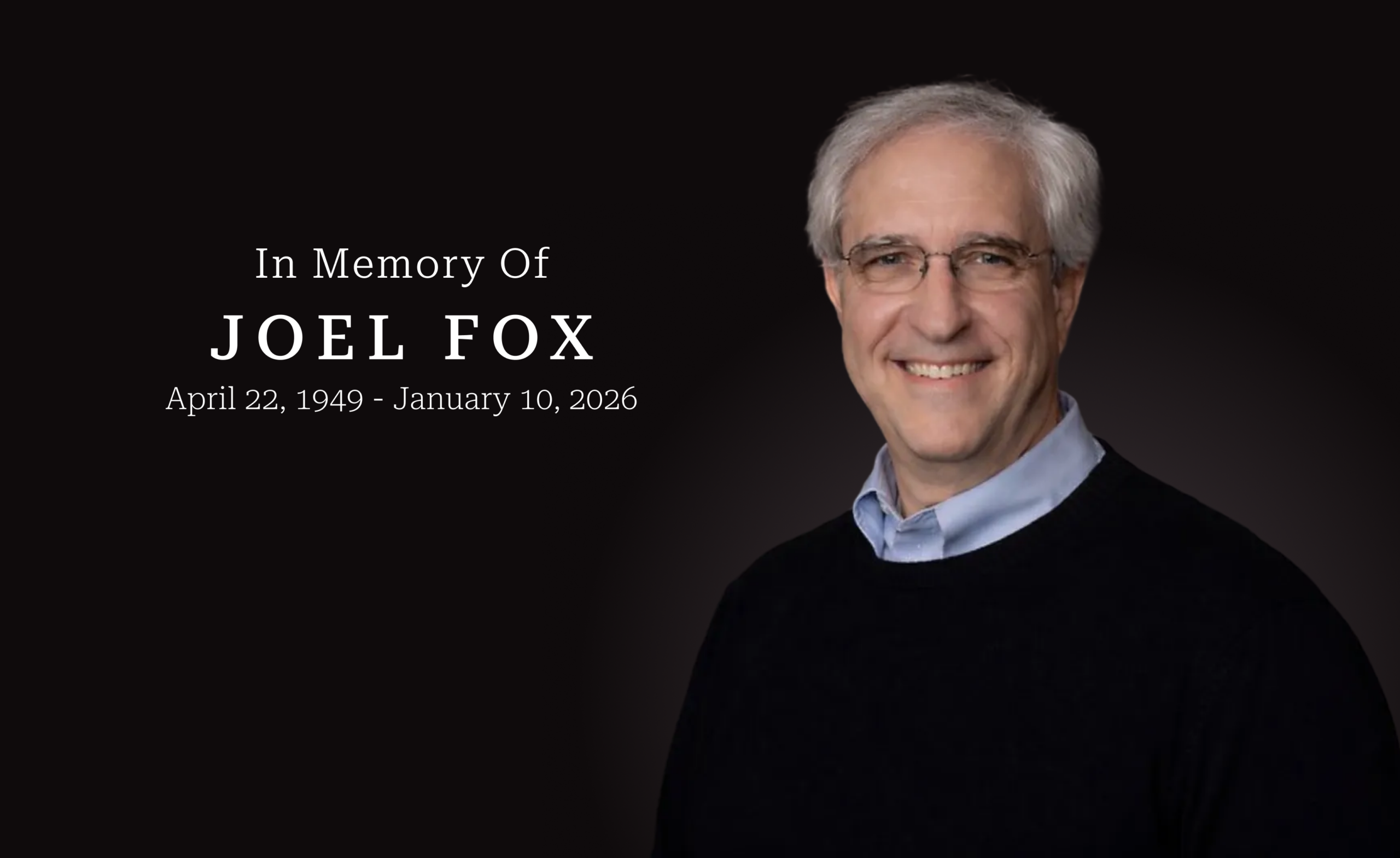
Featured Post

A Fox, A Hound, and a Friendship

If political differences are destined to leave us divided and friendless, how do you explain the life of Joel Fox?

Fox died on January 10 after more than a decade of living with cancer. He was California’s most prominent taxpayer advocate since Howard Jarvis, for whom he worked, and whose anti-tax organization he led from 1986 to 1998. Fox, a Republican, advanced conservative ideas on TV and op-ed pages. He advised the campaigns of Gov. Arnold Schwarzenegger, Mayor Richard Riordan, and U.S. Sen. John McCain.

That profile, in our polarized times, might make you think Fox was one of those political ideologues who are driving the country apart. But the opposite is true.

Fox, more than any person in California politics, built deep relationships with people across the political spectrum. And he did not do this through consensus or compromise. Instead, Fox built friendships on disagreement itself—a warm, open, and curious style of disagreement.


Read More »

Consumers Should Get More Than Just Expense From Green Chemistry

Imagine you’re in the market for a fire extinguisher.  What do you
suppose might be the first question you’d ask of the store clerk who
hopes to sell it to you?

"Does it come in other colors besides red?"  Perhaps you’d ask this,
but it’s not likely to be your first question.  The same goes for "Is
that handle ergonomically designed?"

Chances are the question at the forefront of your mind would be, "Will
this thing actually put out fires and make my home safer?" If you’re
about to pay for a safety measure, you’d want to know whether the
investment will, in fact, enhance your safety.

Read More »

California Business Exodus Now Triple Last Year’s Rate

In executive coaching, there is a saying: "The problem you define is
the one you solve." Based on what I’ve seen, California is in serious
trouble because many people refuse to admit to one of our big problems
– the flight of businesses, capital and jobs to other states and
nations.

Good information about the phenomena is hard to come by. Hence, out of
frustration, a year ago I began compiling a list of what I call
"California Disinvestment Events."

The new compilation shows that 144 companies have fully or partially
engaged in such events during the first three quarters of 2010, nearly
triple the 51 companies discovered for all last year. You can see the
list of companies that disinvest along with explanatory context here.

Read More »

Proposition 25, Taxes and the Brooklyn Bridge

The Yes on Prop 25 campaign’s new TV commercial emphasizes the measure does not raise taxes and punishes legislators if the budget is late.

The No on 25 side (of which I am a part) points out the legislators can avoid the punishment of no pay for failure to produce an on-time budget if the majority simply passes a sham budget, whether the governor signs it or not.

But, it is the tax issue that should receive the focus of voters. While there is a dispute whether taxes can be raised directly through the mechanism of Prop 25, there is no question revenue can be raised to cover the spending in a majority vote budget through increases in majority vote fees, which in many cases are disguised taxes.

Read More »

L.A. Localizes Bad Policy

Some
city of Los Angeles
officials recently proposed an ordinance that would give preference to local
companies when the city buys some good or service. It’s a
well-intentioned, feel-good measure that’s a bad idea.

The
ordinance would give local businesses an 8 percent advantage when they bid for
city work. So in a low-bid contract scenario, a local firm’s bid of $1
million for a city contract would be considered a bid of $920,000. And in a
request-for-proposal scenario, in which bidders are assigned points, a local
business that got 100 points would be considered to have 108 points. Obviously,
that would give local companies a leg up when they’re bidding against
nonlocal companies.

"For
too long, the city of Los Angeles has awarded contracts to private companies
without considering if any of those funds will filter back into the local
economy," City Council member Bernard Parks was quoted as saying in a
city press release.

Read More »

Local Government Scandals, High Salaries, Pensions and Prop 22

Timing is everything the old saying goes and that wisdom may apply directly to Proposition 22 on the November ballot. The goal of the ballot measure’s supporters is to set up a wall between local government funds and a voracious state government. The campaign for passing Prop 22, lead by the League of California Cities, describes the problem as state raids and borrowing of local funds jeopardizes public safety, transit and other vital local services.

But, headlines dealing with local governments over the last few months have been about excessive pay for local officials, free tickets to big-time events, and growing pension and health obligations that put a squeeze on funding local services.

Voters might ask if a shortfall in local budgets is due to the state reaching into local government treasuries or if the problem is self-inflicted by city officials voting for over-generous pay and pension plans.

Read More »

High Speed Rail: Fast Track To Nowhere

Cross-posted at NewGeography.com

Given that Warren Buffett ponied up $44 billion in cash and stock to
take private the Burlington Northern Santa Fe Railroad, I wonder why
President Obama is betting that the way to lift the country out of
stagnant growth is to invest another $50 billion, in public funds, to
swing aboard the dream of high-speed intercity rail.

According to the administration, new money needs to be allocated to
such high-speed rail (HSR) projects as those between San Diego and
Sacramento, Orlando and Tampa, and – my personal boondoggle favorite –
the DesertXpress between Los Angeles and Las Vegas, a $4 billion bet
that getting high-rollers to the blackjack tables will lift the U.S.
economy out of its doldrums.

To establish some track cred, I spend much of my life dreaming about
trains, consulting timetables on how to catch them, and plotting trips
that might end up on night trains to Butterworth (the station for
Penang) or Iasi (change in Ungheni, on the Moldovan border).

Read More »

Counties, Cities Battle ‘Urban Tumbleweeds’

Environmentalists felt a progressive bill was in the bag to make California the first state to ban "urban tumbleweeds" – those ubiquitous plastic shopping sacks.

But the advocates were wrong.

On
Aug. 31, in its end-of-session flurry of horse trading and law making,
the Senate rejected a statewide ban on retailers’ use of throwaway
plastic bags. That came after an end-of-session flurry of lobbying and
advertising by the plastics industry against such a ban.

Read More »

LA Stimulates Few Jobs

How’s that stimulus package working out for Los Angeles? Not too well when you look at the audit report issued by LA City Controller Wendy Gruel yesterday.

The city controller’s report revealed that $111 million dollars in federal stimulus money sent to Public Works and Transportation departments has resulted in a total of 55 jobs created or retained. Well, not 55 exactly, since the audit tests work hours, that’s 54.46 jobs created or retained.

And, while it is good for the individual workers that their jobs were retained, that means many fewer than 55 jobs were created for the $111 million. With two million Californians out of work, many in the most populous city in the state, we need to create jobs. What is going on here?

Read More »

Good Move, Gavin: Mayor Vows To Veto SF Alcohol Tax

Gavin Newsom is a smart man. Yes, I said it.

I’ve
used this forum before to discuss San Francisco’s brain-dead alcohol
tax idea and exposed the fallacious rallying cries behind the proposed
tax.

The feel good idea by San Francisco Supervisor John Avalos
to place a tax on alcohol in an effort to cover city costs resulting
from alcohol abuse was preliminary approved by the San Francisco Board of Supervisors on Tuesday.

Read More »