Featured Post

A Fox, A Hound, and a Friendship

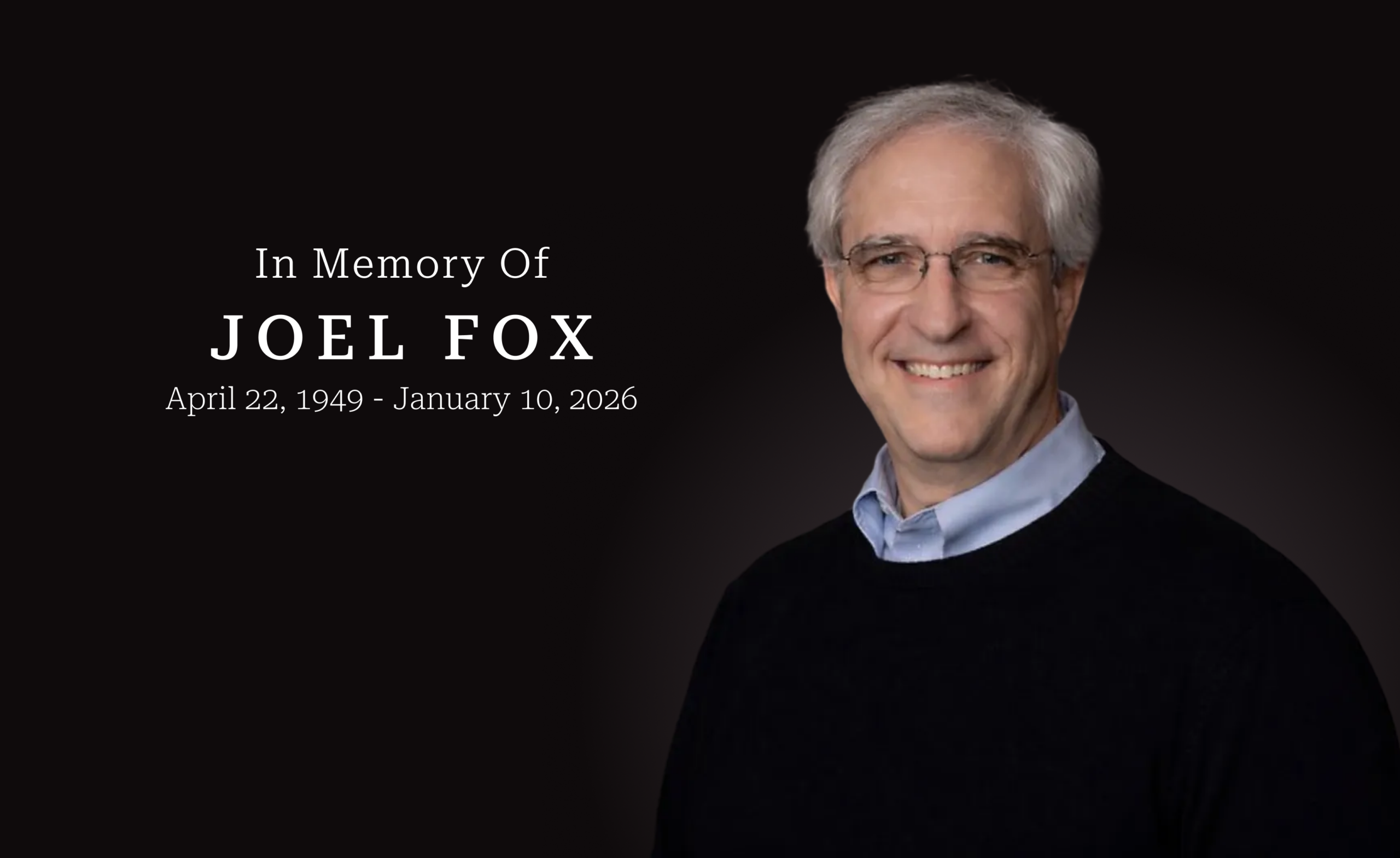
If political differences are destined to leave us divided and friendless, how do you explain the life of Joel Fox?

Fox died on January 10 after more than a decade of living with cancer. He was California’s most prominent taxpayer advocate since Howard Jarvis, for whom he worked, and whose anti-tax organization he led from 1986 to 1998. Fox, a Republican, advanced conservative ideas on TV and op-ed pages. He advised the campaigns of Gov. Arnold Schwarzenegger, Mayor Richard Riordan, and U.S. Sen. John McCain.

That profile, in our polarized times, might make you think Fox was one of those political ideologues who are driving the country apart. But the opposite is true.

Fox, more than any person in California politics, built deep relationships with people across the political spectrum. And he did not do this through consensus or compromise. Instead, Fox built friendships on disagreement itself—a warm, open, and curious style of disagreement.

Read More »

10 New Rules for Public Affairs in the Internet & Social Media Age (part 1)

January of last year, I
blogged about
the Obama 2008 campaign’s success online, calling it the
watershed event for the Internet in electoral campaigns. Since then, we saw at
least one major upset in the 2009 elections (Scott
Brown
) owing in large measure to the Internet. And, more upsets are sure to
come.

While electoral politics is in the throws of evolution, the
broader world of public affairs has yet to see a similar type of watershed
event and, given the less transparent nature of the field, may never actually
experience one in such dramatic fashion. To a technophile like me, this is
unfortunate as these poignant movements are great catalysts for change and
innovation.

Be sure, the Internet is creating significant and lasting
changes and while the goals of public affairs remain the same (building
coalitions, influencing policymakers and impacting public perception/regulatory
environment) the tools and methodologies necessary for continued success are
evolving all around us. To help our public affairs clients take advantage of
the opportunity inherent in these changes, we developed 10 "New Rules" for the
Internet and social media age (outlined below).

Read More »

Howard Would Be Proud!

In communities across the nation, taxpayers are standing tall, gaining strength by reaching out to each other, and becoming a major force for the protection of our constitutional liberties.

This is the type of movement Howard Jarvis hoped would carry on long after his 1978 Proposition 13 revolution. In his book, I’m Mad as Hell he stated “The message of Proposition 13 and its aftermath was clear: People can collectively effect change in the public interest, if only they get mad enough, and if their anger is rational and justified. People who want to do something don’t have to wait for somebody else to lead them: Americans can do things for themselves.”

Howard knew from experience what citizens can accomplish. In 1978, anger over high taxes, especially property taxes that were forcing people from their homes, erupted in an epic battle between average taxpayers and the entrenched forces of California government, including their special interest allies and government employee unions. When the smoke had cleared, Proposition 13, which limited annual increases in property taxes and required a two-thirds vote of the Legislature to increase state taxes, passed with over 65 percent of the vote.

Read More »

What’s the Matter with Wall St. & Why We Still Won’t Fix It

I want to let you in on a little secret. Once upon a time, the Wizards of Wall St. took risks with their own money and, when those risks paid off, they earned handsome rewards. Somewhere in the not too distant past, that changed to the newer model, which nearly sank the world’s financial ship in the Fall of 2008 and likely will again, unless Congress addresses the heart of the problem.

Somewhere around the time that the Glass-Steagall Act was repealed (November 12, 1999, to be precise, by the Gramm-Leach-Bliely Act) the Wizards of Wall St. had a revelation. This light bulb suddenly illuminated, as in the old comics and cartoons, greatly assisted by a major shift of graduate-student-level physicists, weary of stuyding arcane String (Superstring, Membrane, ad nauseum) theories, and math geeks, tired of not making any real money using their mental gymnastics, were looking to escape the hallowed halls of academia.

It was also made possible by the power of modern computing, featuring exponentially increasing memory storage and computing power, enabling billions of calculations in microseconds, all emanating from a computer chip the size of a postage stamp. These academic émigrés were snapped up by the Wizards of Wall St., who called them “Quants,” and set to work, sweating over hot computers, cooking up exotic financial instruments, the understanding of which lay far beyond the ken of mere mortals, to whom an algorithm is a very hard-to-spell word for some kind of math that you did not pay much attention to decades ago when somebody tried to teach it to you. “[A]n algorithm is an effective method for solving a problem using a finite sequence of instructions,” say our pals over at Wikipedia, the People’s Encyclopedia.

Read More »

Brown Debate Idea May be Ahead of it’s Time; But Not This Year

Jerry Brown’s weekend suggestion at the state Democratic convention that a pre-primary debate take place between him and his main Republican rivals is a way for Brown to insert himself into the Republican primary. He is following the example of his one time chief-of-staff and later governor, Gray Davis, who jumped into the 2002 Republican gubernatorial primary. Davis ran ads to undercut his most feared opponent, former Los Angeles Mayor Richard Riordan.

Davis was sitting on enough campaign cash in those pre-billionaire candidate days to afford to spend some campaign funds and weaken his rival. Brown needs to husband all the money he has for a November election battle so his plan is to disrupt leading Republican candidate, Meg Whitman, by drawing her into a three-way debate.

As Riordan rival Bill Simon welcomed Davis’s ads nearly a decade ago, Steve Poizner saw Brown’s move as an advantage to his tough uphill campaign and eagerly agreed to the debate.

Read More »

Main Street Menace: SB 885 (Corbett) – No Gift for Small Business

While the legislature is in session, the National Federation of Independent Business/California will be profiling anti-small business bills and the adverse effect they would have on California’s job creators. This is the first column of the 2010 series.

We’ve all got them in our wallets, purses and desk drawers. They hide from us and we forget that we have them until we “discover’ them again. What are we referring to? Gift certificates – the best one-size-size-fits-all present for those family members or friends that are the hardest to shop for. But as usual, the California legislature can’t leave anything alone…now they’re proposing a change to gift certificates that is no gift for small business, especially mom-and-pop retailers.

Senate Bill 885 doubles the gift certificate redemption provision from a value of $10 to a value of “less than $20” and requires a printed disclosure statement be included on each card or certificate. Doubling the value of the cash-out provision increases the burden already facing small business owners by expanding potential financial liabilities with outstanding gift certificates.

Read More »

Who Will Get the Disappearing California Construction Jobs?

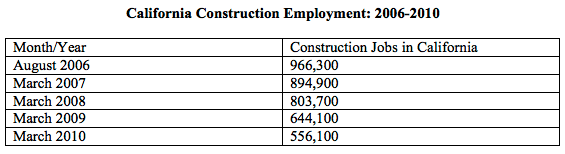
Construction employment in California has been in free-fall since reaching its high water mark in August 2006, as shown in the table below.

Over the past year, federal Stimulus infrastructure projects in California have moved forward and hired construction workers. This is particularly true of transportation projects, for which Caltrans is closely tracking payroll data on employees, hours, and total payroll.

What is not widely recognized, though, is that public infrastructure jobs are only a small part of total construction jobs in California. These public infrastructure jobs are the higher paid construction jobs, but amount to around 10% of construction employment.

Read More »

10,000 in Plesanton say Bailouts Are Not The Answer

In 2000, I did a rally at the Pleasanton Fairgrounds as Bay Area Chairman for Bush-Cheney that drew 5,000 people. I remember at the time, Bush Chairman Gerry Parsky told me that the soon-to-be-Vice President of the United States Dick Cheney “felt like a rock star” speaking before such a large crowd in the Bay Area.

My estimates when I spoke at Thursday’s rally was about 1,000 attendees, but according to the Contra Costa Times, the rally drew 10,000 throughout the day. Those are police estimates – not organizers’ estimates.

The Pleasanton TEA Rally received statewide press this week in the LA Times and San Francisco Chronicle due to organizer Bridget Melson’s un-invitation to “birther movement” leader Orly Taitz, who believes President Obama is not constitutionally qualified to be president. This is crazy talk, and the organizers did the right thing in ousting her from the program. Dr. Melson held an orderly rally – complete with radio talk show hosts, comedians, bands, and oh yeah – political speeches.

Read More »

The Redistricting Commission Won’t Stop Calling

Let me begin by reassuring my wife and family: I am not
having an affair with Elaine Howle.

But I can hardly blame my wife if
she’s suspicious. Howle, the state auditor, and her office have been emailing
me daily for weeks. Over the last week, the obsessive phone calls have started,
wondering where I am and if I’m thinking about what she’s asked me to do.

Howle is in charge of the process
of selecting the new redistricting commission, created by Prop 11, to draw
state legislative district lines next year. And next Monday, April 19, is the
second-round application deadline for anyone who wants to be on the
redistricting commission. I know this because the calls and emails reminding me
of the deadline – and my failure to meet it – never stop.

At first, these missives were
helpful-they referred me to workshops and organizations that would help me
complete the application. But in recent days, the tone has grown more urgent,
more pleading – part doctor’s office wondering why you won’t call for the test
results, part over-caffeinated professor who thinks you’re going to turn the
paper in late again.

Read More »

Reading the ‘Tea’ Leaves

Yesterday marked the 1-year Anniversary of the Tea Parties heard ‘round the world.

As the Event Director at two of the largest Tea Parties in the United States televised on FOX News, I am often asked, “What is the future of the Tea Party movement?”

My fellow Californians, I can tell you this: The state of the Tea Party is strong, and it is here to stay.

During “Tax Day” yesterday, one only needed to walk over to the steps of the Capitol to witness thousands of people fed up with their government. In California, of all places – the most Liberal state in the union. Thousands strong, this crowd didn’t exist two years ago. They certainly didn’t exist in 2005 when Governor Schwarzenegger was trying to change the system. Just imagine if they had.

In fact, if you’ve never actually attended a Tea Party in person and have only seen them on MSNBC, you might be of the opinion that they’re all a hostile, angry bunch. Think again.

Read More »