

Furloughs and Fat Fabian
One public employee group wants the governor impeached for suggesting two day a month furloughs for public sector workers. The furloughs amount to a 10% pay cut for the workers. I don’t remember the thousands upon thousands of private sector workers who lost their jobs calling for the governor’s head. When my consulting business suffered a more than ten percent loss a few months back, I didn’t start a recall petition on the governor. What is it with the public employees?
Loren Kaye on this site did an excellent job of pointing out how California’s public sector employees are reacting quite differently from private sector employees to the difficult economic times. Democratic elected constitutional officers, who declared they would not furlough their workers, aided the public employees’ stance. I hope those elected officers sent out notes of sympathy to fired private sector workers who lost their jobs as quickly as they objected to the governor’s orders to furlough their employees for a couple of days a month.
Tax reform now, or at least a rough draft
It’s only been a month since the appointment of members of the tax reform commission that was the brainchild of Assembly Speaker Karen Bass. My question to the commission: you folks got any recommendations yet?
Because the state could sure use some thoughtful tax proposals. Right. Now. With the state facing a cash crunch (in fact, there’s already a cash shortage that will cause real pain even if the legislature and governor reach an agreement on a plan to address the budget shortfall today), California’s leaders have to raise taxes. So there’s no better time to advance tax reform. If we had strong recommendations from the commission, they’d have a chance of becoming law. And state leaders might be able to say, with some pride, that they took advantage of a miserable situation to make some important changes in how California is governed. The crisis was too good to waste and all that.
At the very least, recommendations from a tax reform commission might shape a more productive debate about the budget. Right now, the back and forth is all about brinksmanship and games of chicken. Will Democrats cut the budget more? Will Republicans finally back down and support tax increases? Can they reach a compromise, or can the Democrats find a way around the requirement of a two-thirds vote on budget and tax issues?
Does California have a revenue problem or a spending problem?
The answer is probably “both,” but it is usually informed more by ideology than analysis. The following may be useful in guiding policy makers’ decisions on how much in new taxes versus program cuts to implement:
1. Over time, California has stepped up its spending, after adjusting for population growth and inflation. That is, the absolute level of public services has generally increased over time. The following chart shows that inflation-adjusted per capita spending over the past thirty years – since the passage of Proposition 13. For the first couple decades, spending ranged from $900 to $1,100 per capita, over the past decade, spending has averaged $1,100 to 1,300 per capita.
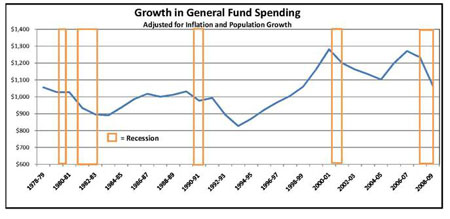 Growth in General Fund Spending
?
New Nationwide Study Reveals Low Civic Participation in California despite High Election Turnout
The British journalist, Harold Evans, once commented, “For America to work, Americans have to participate. If they don’t pay attention, they’re going to get screwed.” This is, albeit crudely, true of America, but it is even more applicable to the Golden State, where Californians appear to sit in stunned silence as we witness (from a distance) the slow motion train wreck that is the state budget process. This alienation from the gears of government – both in Sacramento and locally – has been decried from many quarters, but, for the first time, a statewide report has just been released quantifying disappointingly low levels of civic participation among Californians.
Co-sponsored by the organization I lead, Common Sense California (CSC), and produced by the Congressionally chartered, National Conference on Citizenship (NCoC), the “2008 California Civic Health Index,” measures citizen engagement in several ways. NCoC had published a national version of this study last fall, but the California study, which involved a representative sample of over 400 Californians has just come off the press. The main results reveal that even with the higher levels of participation in the 2008 elections, Californians vastly underperform the rest of the country in habits like volunteering and participating in local problem solving.