

Redevelopment Decision Necessary Stopgap Measure
On top of the news that state revenue is falling short of what was anticipated by $3 billion, comes the decision from Superior Court Judge (and former state legislator) Lloyd Connelly that the state can shift $2 billion in local redevelopment funds to schools.
Redevelopment agencies will appeal the decision. But, if nothing else, Judge Connelly’s decision will force a hard look at the effectiveness and oversight of the redevelopment process and that is a good thing.
By declaring "blight" in communities, redevelopment agencies can use the power of eminent domain to seize property and develop the blighted areas while attaching the "tax increment" revenue to the redevelopment agency. The "tax increment" is the new property tax revenue that is the amount of taxes above what the property was paying when it was "blighted." The new revenue stays with the redevelopment agency and is not available for schools and other county government services.
No Surprise In State Tax Returns
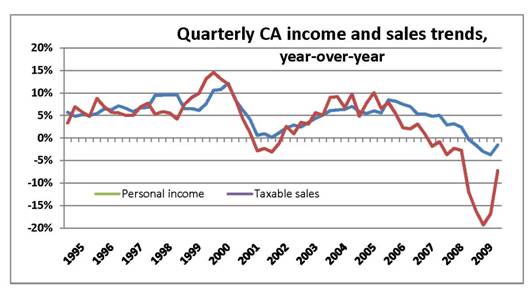
The April surprise in state tax returns
this year should be no surprise – except to those who crave the fantasy
of painless solutions over the economic reality of every day
California.
After all, what in the personal income and retail sales
numbers could have spurred this unwarranted optimism?
California is Too Big To Fail; Therefore, It Will Fail
Cross-posted at NewGeography.com
Back in December I wrote a piece
where I stated that California was likely to default on its
obligations. Let’s say the state’s leaders were less than pleased.
California Treasurer Bill Lockyer’s office asserted that I knew
"nothing about California bonds, or the risk the State will default on
its payments." My assessment, they asserted, "is nothing more than
irresponsible fear-mongering with no basis in reality, only roots in
ignorance. Since it issued its first bond, California has never, not
once, defaulted on a bond payment."
True Impact on Working People of AB 32 is No Mere Numbers Game
It’s time for an honest discussion about how California’s global warming law (AB 32) will impact jobs in California. Working people in this state are suffering and they need real answers about its job impact, not theories, legacy politics and empty promises.
Consider a few grim statistics: The state’s unemployment rate is still above 12 percent.
More than 119,000 manufacturing jobs were lost last year. More than 600,000
manufacturing jobs have been lost in this state since 2000. Blue collar workers in the
building trades have been particularly hard hit, with unemployment rates at some local
unions as high at 30 percent to 40 percent.