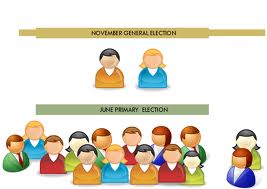
If We Did Not Have The Top Two Primary …
If we did not have the top two Open Primary Election on June 5 … Brad Sherman would be returning to Washington, D.C. as David


If we did not have the top two Open Primary Election on June 5 … Brad Sherman would be returning to Washington, D.C. as David
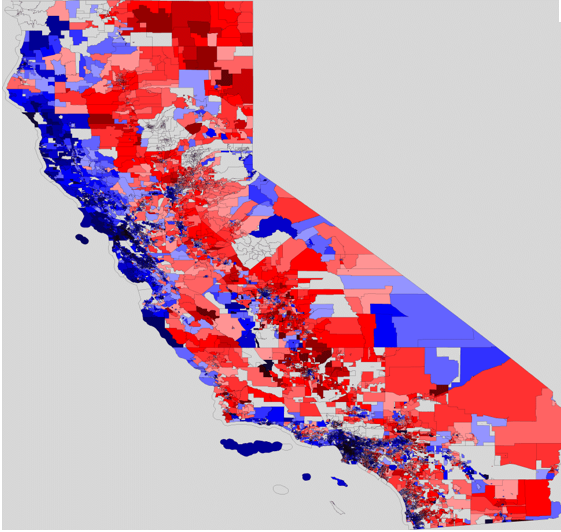
Last Monday I wrote that as many as 34 of the contested races in the June Open Primary could lead to a same party runoff
When Bette Davis spoke the above line in the classic movie, All About Eve, I’m certain she did not have California politics in mind. But
The passage of Proposition 14 in the June 2010 Primary Election set into place a significant change in how we elect our representatives in Congress,

Editors of the California Target Book, which I publish, has recently finished and placed online their analyses of the 80 Assembly districts and 53 Congressional
Last week, I made my early picks a to where the action may
be for Congress and the state Assembly in November 2012. Now, lets look at the
state Senate.
First, only the 20 odd-numbered districts are up for
election in 2012, and, barring a successful court challenge or referendum, the
candidates will run in one of the newly drawn districts that the Citizens
Redistricting Commission, in their final vote, are expected to approve today, August
15.
Senators elected in 2010 in one of the 20 even-numbered
districts were elected to a four-year term and will represent those districts
as drawn until the end of their current term in 2014. Should any of these
senators resign his/her seat, a special election would be held to fill the
unexpired term, but the election would be held under the old lines. The newly
drawn even-numbered districts do not become legal until the 2014 election
cycle.
Here are the odd-numbered senate districts that I pick as
possibly being competitive, with the more likely targets being listed first.
In my last post, I made my early picks as to where the
action will be in November 2012. Now, let’s look at the new congressional
districts that may be in play in November 2012.
3rd
Congressional District: JOHN GARAMENDI (D). Garamendi resides in the
southern portion of this new district and only 22% of the voters reside in his
old district. The district stretches north to encompass large areas that are
currently represented by Reps. Wally Herger (R) and Mike Thompson (D). Jerry Brown
outpolled Meg Whitman 50% – 43%, while Carly Fiorina narrowly outpolled Barbara
Boxer 46% – 45%. This is not a safe Democratic district, so let’s see if
Republicans can recruit a top tier candidate to challenge him.
7th
Congressional District: DAN LUNGREN (R). Lungren will again face his 2010
opponent, Ami Bera. But Asm. Alyson Huber (D), who was not treated
well in the Assembly redistricting, has made noises of possibly entering this
race. Brown outpolled Whitman 50% – 45%, while Fiorina outpolled Boxer 49% –
43%. This will be a top TARGET.
Should the new lines for the 80 assembly districts released
by the Citizens Redistricting Commission (CRC) become final on August 15 –
meaning there are no successful legal challenges or referendum that could
require the state Supreme Court to draw the lines – following are my early
picks as to where the action will be in November 2012 (Part Two will cover
state senate and congressional races)
Those who were hoping that lines drawn by the CRC, rather
than politicians, would significantly boost the number of competitive races in
2012 will be sorely disappointed. It didn’t happen.
Here are the assembly districts that early handicappers are
currently looking at as being competitive, with the more likely targets being
listed first.
On July 10, the Citizens Redistricting
Commission released their first draft of the newly drawn lines for
congressional, state legislative and Board of Equalizations districts.
Not surprisingly, several incumbents
weren’t too please, particularly those who found themselves located in a new
district where one or more fellow incumbents also resided or, in the extreme,
no district to run in at all.
But aside from them, the loudest cries
came from Latino and Republican leaders … two groups that seldom agree on
anything political.
To understand this, one has to first look
at the 2001 redistricting plan, a highly gerrymander plan drawn specifically to
protect the incumbents of both political parties.