

Author: Loren Kaye

You can’t make this stuff up

Upon viewing some foolishness perpetrated by California leaders, some pundits would harangue that “California is run like a third world country.”  Turns out that’s an insult to third world countries, if this Wall Street Journal article is any indication:

SANTIAGO, Chile — During the emerging economies’ commodities boom a few years back, Chilean Finance Minister Andrés Velasco was a wet blanket at the fiesta. Chile, the world’s largest copper producer, was reaping a bonanza from the quadrupling in the metal’s price. Mr. Velasco insisted on squirreling away a large chunk in a rainy-day fund.
Read More »

Mini-Prop 13

Ironically – but perhaps fatefully – Proposition 1A lost by about the same margin by which Proposition 13 prevailed: 30 points. Many things are different between yesterday’s election and the one held in June, 1978, but they certainly have this in common: the lessons that elected officials take from voters will have big consequences down the road.

In 1978, Proposition 13 not only brought tax skepticism to the top of the political order, but the then-“obscene” budget surplus allowed the Legislature to soften the blow to local governments, thereby postponing the day of reckoning and creating entanglements between state and local and school finances that bedevil us to this day.

In 2009 it is now the budget deficit that is obscene. The Legislature will choose from among many options to address this challenge, but the lesson from 31 years ago is that the most expedient choices may create even more intractable problems in the years ahead.

Read More »

Now the Governor knows how the Bank and Auto CEOs feel

This probably isn’t what Mac Taylor had in mind.

When giving advice on solving the state’s desperate cash flow crisis, the state’s Legislative Analyst acknowledged that federal loan guarantees could be helpful, but cautioned about accepting federal help with strings attached:

“We recommend that the Legislature agree to no substantial dimin­ishment in the role of California’s elected state leaders. In our opinion, the difficult decisions to balance the state’s budget now are preferable to Californians losing some control over the state’s finances and priorities to federal officials for years to come.”

Well guess what, the puppet master has already appeared , and it’s not cash flow that’s on the line, but nearly $7 billion in federal stimulus funds. Turns out that one of the budget cuts hammered out by the Governor and legislative leadership, saving $74 million by reducing the pay of home care workers, has run afoul of the powerful union that represents these workers.

Read More »

How to blow up a spending limit

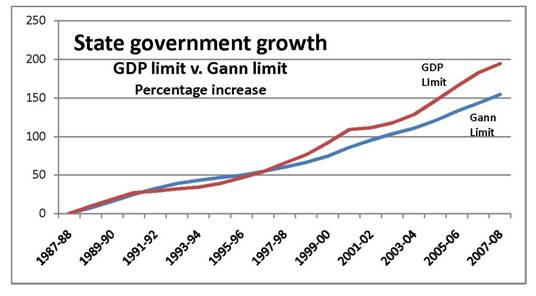
While attacking the spending limit for being too weak, “Anti-Tax Advocates” seem to have created their own confusion over spending limits. After weeks of denigrating Proposition 1A, even though it uses the venerable Gann Limit factors (population plus CPI) to limit revenue growth to control the revenues from the rainy day fund when needed, the advocates have suddenly scrambled to concoct an alternative to the so-called hard cap of population and CPI growth.

As stated in these pages last week, and reported again over the weekend, anti-tax advocates would prefer to limit spending not based on the Gann factors, but based on GDP growth. But, as the chart below shows, after 20 years spending under such a plan, the limit would have been $13 billion HIGHER than under the Gann Limit. No wonder the public employee unions have joined forces with them to oppose Proposition 1A.

State Government Growth: GDP Limit vs Gann LimitState Government Growth: GDP Limit vs Gann Limit

Read More »

College is for California

If you harbor any doubts that California must urgently prepare all students for college – and ensure they then graduate with a four-year degree – please spend a minute with this important recent study from the Public Policy Institute of California (PPIC).

Hans Johnson and Ria Sengupta, extending earlier work by PPIC, found that California’s economy will inexorably increase its demand for a highly educated workforce, but “the state is unlikely to meet this demand unless decisionmakers implement policies that effect substantial changes in college attendance and college graduation among the state’s young adults.”

Read More »

Axing the high school exit exam?

The enemies of accountability for schools and high performance for students were out in force on the occasion of a bizarre study from Stanford and UC Davis researchers.

Most disconcerting was a victory dance by a business organization claiming the high school exit exam a “failure.”

First, it’s more than a little unseemly to flack a policy outcome (in this case, mandated vocational education programs) by incorrectly claiming that the exit exam is a failure. Heck, the study’s authors didn’t even claim that.

Read More »

Dreadful employment picture

You may have heard that the California unemployment rate for March was reported to be 11.2 percent https:> , an increase of 0.6 percentage points from February, exceeding even the peak unemployment rate of the 1981 recession (11 percent).

California may not have seen such a high monthly unemployment rate since the 1950s or even the 1940s. But recall that during the 1981 recession, which was relatively short, the unemployment rate stayed at or above 10 percent for 12 consecutive months.

But the picture gets even worse when you compare the job losses for this recession with the three previous recessions over the past 30 years. The chart below shows that California job losses (as a percentage of total nonfarm employment at the peak of the cycle) in this recession have been deeper and accelerated faster than during any of the previous recessions.
?

Read More »

California Housing: Ready to Recover?

More good news and bad news for the California housing economy.

Home prices continue their unabated decline, but existing home sales are on a roll – especially in inland California. New housing starts are still anemic, but government programs are poised to subsidize that end of the market.

First the bad news:

California home prices continued their freefall into 2009. The Standard and Poor’s monthly index of metro home prices showed California registering another record year-over-year drop. The composite average for San Francisco, Los Angeles and San Diego prices dropped in January by 27 percent from the previous year, the same as December’s year-over-year drop, but short of the recorded by the state, and exceeded only by the Sunbelt cities of Phoenix and Las Vegas.

Read More »

Prop 1A is the real deal

Opponents of Proposition 1A need to stop watching Saturday morning cartoons long enough to read a copy of the ballot measure. The budget reform on the May special election ballot is not Proposition 58 redux; it is in fact the fix to Prop 58 that the Legislature refused to enact in 2004 – but which Republicans insisted as their price for agreeing to this year’s budget solution.

Proposition 58 did not place a limit on spending. Proposition 1A caps revenue growth to the average growth of revenues over the past 10 years – which will provide an effective damper on state spending increases. Don’t take my word for it, ask the California Budget Project, a liberal think tank, which recently reported that “the revenue forecast established by Proposition 1A, which limits spending from the state’s existing tax base, would be significantly below the Governor’s ‘baseline’ spending forecast.” Any revenues that exceed that trend are automatically deposited into the rainy-day fund.

Read More »