Author: Loren Kaye

Selflessness and, well, something else

President Barack Obama, January 20, 2009:

For as much as government can do and must do, it is ultimately the faith and determination of the American people upon which this nation relies. It is the kindness to take in a stranger when the levees break, the selflessness of workers who would rather cut their hours than see a friend lose their job which sees us through our darkest hours.

California Controller John Chiang, January 21, 2009:

Democratic State Controller John Chiang said Wednesday he will refuse to reduce state worker pay as demanded by Gov. Arnold Schwarzenegger, possibly sparing more than 200,000 public employees from furloughs and pay cuts.
Read More »

The Anti-Stimulus

The state budget abyss draws closer, and the first victims – surprisingly – are not public employees or school children or poor people, but instead are working men and women, many with union cards.

State construction projects are grinding to a halt, triggered by a decision last month by a crucial state finance agency to halt working capital for state-financed projects. This has led to a cascading effect on state construction projects, placing at risk more than 5,700 projects valued at $22.5 billion.

Read More »

Does California have a revenue problem or a spending problem?

The answer is probably “both,” but it is usually informed more by ideology than analysis. The following may be useful in guiding policy makers’ decisions on how much in new taxes versus program cuts to implement:

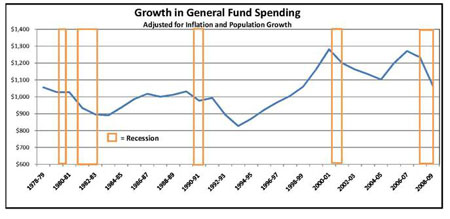
1. Over time, California has stepped up its spending, after adjusting for population growth and inflation. That is, the absolute level of public services has generally increased over time. The following chart shows that inflation-adjusted per capita spending over the past thirty years – since the passage of Proposition 13. For the first couple decades, spending ranged from $900 to $1,100 per capita, over the past decade, spending has averaged $1,100 to 1,300 per capita.

Growth in General Fund SpendingGrowth in General Fund Spending

?

Read More »

Housing continues slide in California

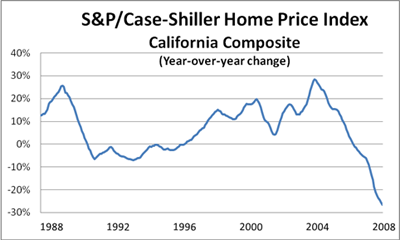
The bottom to the California home price free-fall is still not in sight. Last week Standard and Poor’s released its monthly index of metro home prices, and California still registers a growing year-over-year drop. The composite average for San Francisco, Los Angeles and San Diego prices dropped in October by 28 percent from the previous year, the largest year-over-year drop recorded by the state, and exceeded only by the Sunbelt cities of Phoenix, Las Vegas and Miami. As you can see from the chart below, the trend is accelerating.

According to this index, California’s composite home prices are equivalent to where they were about five years ago, in the summer of 2003.

?California Composite Home Price IndexCalifornia Composite Home Price Index

Read More »

Save the Columbus Day holiday!!

While we should expect that public sector labor would defend every privilege they have gained for their members, it is still astonishing that state unions and their patrons would consider their positions immune from the ravages of the state’s budget debacle.

With every other politician claiming we are in the worst economic downturn since the Great Depression, state unemployment rising to 8.3%, and consumer confidence falling to an all-time low, since when are reductions in state government personnel costs off limits? Indeed, Gov. Schwarzenegger has proposed what are probably the least harmful approaches to the current state workforce to minimize layoffs by a combination of furloughs, salary reductions, and reducing some state holidays, like Columbus Day.

Read More »

Flim and Flam

Only hours after being sent a package of tax increase bills by the Legislature, Governor Arnold Schwarzenegger held a news conference yesterday to announce that he would reject the Democrats’ flim-flam. The flim was the unlawful tax increases. The flam was the parody called “economic stimulus.”

The Governor said the package “fell short on every single level,” and in particular called out the obvious lack of reforms that would aid the state in recovering from the economic recession. He indicated that the package did not include economic stimulus provisions that were needed, including relaxed state workplace rules and streamlined environmental laws to expedite public works projects. The Governor’s summary of the Legislative economic package: “It actually doesn’t do anything and it makes it more difficult, actually, to do certain projects.”

The Governor also indicated his displeasure with raising taxes on working families during an economic downturn. In fact, the tax increases approved by the Legislature are a slap in the face to voters, who (1) rejected Proposition 56 in 2004, which would have eliminated the two-thirds vote requirement for state tax increases, and (2) rejected Proposition 87 in 2006, which would have imposed an oil severance tax similar to the one approved by the Legislature yesterday.

The Governor appropriately called the Legislature on its attempted subterfuge. Now it’s back to the negotiating table to navigate a solution that keeps faith with voters, the Consitution and the fragile California economy.

Read More »

Reducing greenhouse gases in California – they still won’t tell us the cost

Next Thursday the California Air Resources Board (CARB) will achieve a milestone in environmental regulation when it will likely adopt a Final Scoping Plan to implement the Global Warming Solutions Act of 2006. Perhaps the most far-reaching regulatory effort ever undertaken by a governmental agency, this plan will touch every aspect of Californians’ lives and the economy. But lost in the ceremony surrounding the plan – adopted even as California tumbles into the worst recession in a quarter century – is an honest assessment of its effect on Californians and our economy.

The Board has proposed an exhaustive list of measures to achieve a 30 percent reduction in California’s greenhouse gas emissions by 2020 – from what would have been a “business as usual” pace, or an absolute 15 percent reduction from today’s levels. This will require enormous investments in renewable energy technologies, smaller and more fuel efficient automobiles, and pervasive, expensive energy efficiency measures, as well as reduced driving and other energy-intensive economic activities.

Read More »

Can the feds bailout California?

Speaker Bass has taken the position that the Legislature has already made $10 to $12 billion in cuts over the past several years, and enough is enough. Therefore, her preference in addressing the budget deficit is "I want to do 50 percent revenue and 50 percent from the federal government." This is an understandable position from a Democratic Speaker, but is it practical? After all, with a twenty-month budget deficit pegged by the Legislative Analyst at $27.8 billion, could we expect Washington to deliver $13 billion or so next year just to California?

Read More »

California Housing Blues

If you’re looking for a bottom in the California home price free-fall, keep looking. Standard and Poor’s released its monthly index of metro home prices, and the outlook is dismal for Sunbelt states, and for California in particular. The composite year-over-year average of San Francisco, Los Angeles and San Diego prices dropped in August by 27 percent, accelerating a trend that began in December of 2006.

Home Price IndexHome Price Index

Read More »