

Author: Michael Bernick

The Changing Job Landscape for California’s Media Access Office

The Media Access Office (MAO) was founded in Hollywood in 1979 by Fern Field Brooks, and Performers with Disabilities, a group of experienced and aspiring entertainment professionals. The group included performers with a range of physical conditions (wheelchair users, amputees, hearing impaired, sight impaired) as well as neurological conditions (performers with Down syndrome, autism, Tourette syndrome). 

MAO set as its missions to increase employment opportunities in front of the camera, as well as to change the way that persons with disabilities were portrayed in the movies and television. 

MAO grew slowly during the 1990s and early 2000s from a small non-profit into a statewide program under the direction of  and funding from the Governor’s Committee for Employment of Disabled Persons and its longtime director, Catherine Kelly Baird. In the past few years, MAO has downsized considerably due to state budget cuts. Still it remains very active in both the north and south of the state.
Read More »

California’s Explosion in Involuntary Part-Time Employment

The number of  unemployed in California, the rate of unemployment, the average duration of employment: all of these indicators have risen dramatically since 2007. However, there is a further less-known job indicator that also has arisen dramatically, and that may have more to do with stalling a job recovery in California than any other: the number of workers involuntarily working part-time.

The table below shows the explosion of involuntary part-time employment in California since summer 2007. It was compiled from data provided by economist Paul Wessen of EDD’s Labor Market Information Division.

Californians Who Work Part-Time But Seek Full Time Work (April 2005-April 2010)

Read More »

Balboa Island

When I started posting, I told our publisher, Joel Fox, that I’d only write  on the dynamics of jobs in California. But I think he’ll indulge me on the post below about a segment of California past-and hopefully future.

Donna and I were at UC Irvine recently, and took the opportunity with our oldest daughter Sonia to drive to Balboa Island.

From the university to the Island is a short drive straight down Jamboree. The hilltops above Jamboree are filled with oversized condos and apartment complexes. But as you cross the Pacific Coast Highway, the road narrows to a two lane bridge, the condos and apartments disappear, and you find yourself on Marine street, the main street for Balboa Island.

Read More »

The City of the Long Term Unemployed in California

Not only have the rates of unemployment and underemployment (particularly involuntary part-time work) increased dramatically in California since 2007, but so also has the average duration of unemployment. In fact, as the chart below illustrates, long term unemployment (employment for 27 weeks or over), has increased more rapidly than other unemployment measures both in total numbers of Californians and percent of the unemployed .

Unemployment by Duration: California,  March 2006-March 2010

Read More »

California’s Entrepreneurship Among the Ruins

I’ve discussed California’s entrepreneurship and the current recession in several articles over the past year (here, here, & here).

This past week brings new data on business incorporations during the recession from Ms. Philly Crosby of the Secretary of State’s office. These data continue to show the strength of California’s entrepreneurs.

Below is a summary of the new business incorporations from 1999-2009.

Read More »

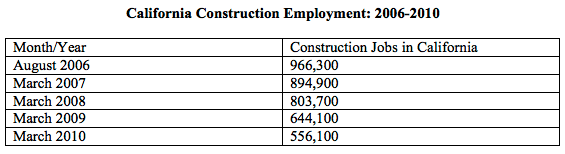
Who Will Get the Disappearing California Construction Jobs?

Construction employment in California has been in free-fall since reaching its high water mark in August 2006, as shown in the table below.

Over the past year, federal Stimulus infrastructure projects in California have moved forward and hired construction workers. This is particularly true of transportation projects, for which Caltrans is closely tracking payroll data on employees, hours, and total payroll.

What is not widely recognized, though, is that public infrastructure jobs are only a small part of total construction jobs in California. These public infrastructure jobs are the higher paid construction jobs, but amount to around 10% of construction employment.

Read More »

Fresno: Job Training When Unemployment is 18.5%

The most recent state unemployment numbers (February 2010) show a number of California counties with unemployment rates soaring near to or over 20%: Imperial, 27.2%, Colusa, 27.6%, Merced, 22%, Tulare, 18.7%, and Fresno, 18.5%.

To an extent these rates are misleading. Even when the state economy is running smoothly, these counties, with significant agricultural employment, have unemployment rates over 10%. With the agricultural base, a level of seasonal unemployment is built into the local economy.

Yet, as Fresno County indicates, the current unemployment even in agricultural counties is a far different situation than in previous years. Tim Sheehan notes in a recent Fresno Bee article that the current unemployment in Fresno County (with a labor force of 441,300, the largest of the agricultural counties) is the highest unemployment rate in 17 years. The total number of unemployed is 81,800, the largest number ever.

Read More »

Staffing Companies: Canary in California’s Employment Mines?

Contingent employment in California—employment outside of the traditional employer-employee relation—has been growing for more than two decades in California. This growth has included increases in independent contractors, self-employment, employment leasing, and most of all, in staffing employment, which regularly totaled over 420,000 payroll jobs in California until this Great Recession.

The chart below compiled with the assistance of Mr. Spencer Wong of EDD, shows the changes in staffing employment from October 2001 through October 2009. Staffing company employment in California—both jobs within the staffing companies and jobs in client companies—is included in the “Employment Services” sub-sector category of the EDD monthly labor reports. Since the sub-sector numbers are not seasonally adjusted, the chart below focuses on the same month, October, for each of the following 9 years.

Read More »