

Author: Michael Bernick

Amateur Hour at the Whitman Job Analysis Show

In the Governor’s race, the primary jobs discussion in the final month should be about the next 4 years and beyond, and strategies for job growth and sustainability.

However, the Whitman campaign continues to make Jerry Brown’s governorship from 1975-1981 a main issue, including the claim that it was a time of job loss and unemployment. As someone involved in job training during that time, I didn’t recall it that way, and dug up the payroll job growth during that time and the terms of subsequent governors. The research showed a 1.9 million job growth during Brown’s governorship-a larger share of the national job growth than any subsequent time.

A few days ago, Marc Lifsher of the Los Angeles Times wrote of a new study by an economist at Claremont McKenna College that is being pushed by the Whitman campaign as evidence of Brown’s employment  failure. Claremont McKenna is one of our leading colleges in California. The study was conducted by the Lowe Institute of Political Economy. 
Read More »

The Brownian Motion of the California Workforce

The California economy is often  described  today as stagnant. The latest state unemployment numbers covering  August 2010 showed unemployment  changed  only slightly to  12.4% and minimal movement in net payroll jobs-a loss of 33,500 payroll jobs over the month out of 13,827,900 payroll jobs overall in California.

Of course, below the surface of these numbers , there is enormous movement of jobs and workers.  I have posted several times of the enormous job creation and destruction going on each month in California (roughly 220,000-250,000 jobs continue to be created each month and an equal number destroyed, even during the Recession).  Data recently released in the federal  Department of Labor’s Job Openings  and Labor Turnover (JOLTS) report indicate the Brownian motion of workers among existing jobs. Even in the Recession, workers are moving in and out of jobs at a rapid pace. Some of this movement reflects voluntary separations ("quits") , a greater amount of the movement is due to   involuntary separations ( "layoffs/discharges")

The chart below, taken from this JOLTS report, indicates nationwide the number of Separations-quits and layoffs/discharges-both before and during the current Recession, through July of this year. 

Read More »

Labor Day 2010 and the Dog that Didn’t Bark

As we arrive at Labor Day 2010, the job numbers remain the worst in California since World War II in California, and some of the worst in the nation since World War II. State unemployment is at 12.3%– and would be higher, except that the number of workers counted as seeking work has declined.

Payroll jobs through July 2010 stood at 13,874,900, down slightly more than14,000 jobs from July 2009-and down from a high of 15.2 million jobs in July 2007.

The severe job losses we saw in the first half of 2009 (which topped over 100,000 net jobs lost in January 2009 alone) stopped by last Labor Day, and we have not seen similar losses since. But neither have we seen any significant net job gains. The dog hasn’t barked in the night, and the past year in California employment has been characterized mainly by what has not occurred rather than what has.

Read More »

Governors and Jobs

Over the past year, I’ve been engaged in a research project on the transformation of employment in California since World War II. The project has involved research on the shifting employment relations in California (particularly the breakdown of the employer-employee relation and rise of contingent employment) as well the ebbs and flows of job creation and employment.

The chart below shows the growth and decline of total payroll jobs in California during the five recent governors, beginning with Jerry Brown.

Read More »

The March of California’s Unemployment Insurance Fund

California’s Unemployment Insurance (UI) Fund  has continued to go deeper and deeper in debt through 2010-a debt of $7.6 billion at present, projected now to grow to $18.4 billion by the end of 2010. But 2010 has not been all negative for the Fund.

This year has seen advancements in a series of  Fund Information Technology projects that should improve call center operations, enable claimants to access their records and file and check claims via the internet, and enable the state to pay claims electronically and with greater security.

Read More »

Paging Professor Wagstaff

In the 1932 movie, Horse Feathers, Groucho Marx plays Professor Adams Wagstaff, the new president of Huxley College. Professor Wagstaff decides to recruit  two older students, who he mistakenly believes to be professional football players, to enroll in Huxley and help Huxley defeat its rival Darwin. Chico (Baravelli, the iceman) and Harpo (Pinky, the dogcatcher) enroll at Darwin, where they, with Groucho, Zeppo and Connie Bailey, the "college widow",  predictably create chaos at the college.

Read More »

Positive Resource Center at a Time of Job Scarcity

For the past year, each announced job opening in San Francisco and throughout the Bay Area has attracted tens of applicants, usually hundreds of applicants. The great surplus of applicants has been across occupations and across sectors: waiters, administrative assistants, lawyers, accountants, loan officers, staffing companies-you name it.

So what is the role of the job training/job placement agency in such a time when there are so few jobs?

Positive Resource Center (PRC) is one of the premier community job agencies in California. It is located on Market Street near Fourth, and has been in operation for twenty three years. It focuses on individuals affected by or at risk for HIV/AIDs, and serves around 2500 individuals annually.

Read More »

The Storyline of This Recession in California

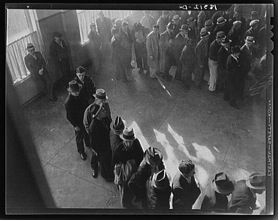
The storyline of this recession in California has yet to find its place in California literature. It will over the next decade; and it will be a storyline very different than those of  the previous economic downturns over the past 70 years.

Our thinking about California recessions and depressions has been greatly influenced by novels and movies. When we think of the Depression we think of the Joads, uprooted from their land by economic forces beyond their control, driven from Oklahoma to California to be part of a reserve army of other uprooted farmers.

The Grapes of Wrath, first as a novel published in 1939 and later as a 1940 movie directed by John Ford fixed the Depression as due to the uncontrolled workings of the market economy, and helped cement the Keynesian consensus that has governed California and the nation for most time since.

Read More »

Will Hiring Ever Return in California?

Will Hiring Ever Return in California?

That’s a question policymakers, job seekers and friends and relatives of job seekers are asking in the wake of the recent state unemployment numbers released a few weeks ago. Despite some attempts to put a positive spin on the numbers (the unemployment rate went down from 12.6% to 12.4%, the payroll jobs increased by 28,300) the numbers showed an economy that remains sluggish in terms of hiring.

The payroll job gain was the result entirely of additions in federal government employment, which were the temporary census jobs. Private sector jobs showed a net decline, as did jobs in state and local government.

Read More »