

Featured Post

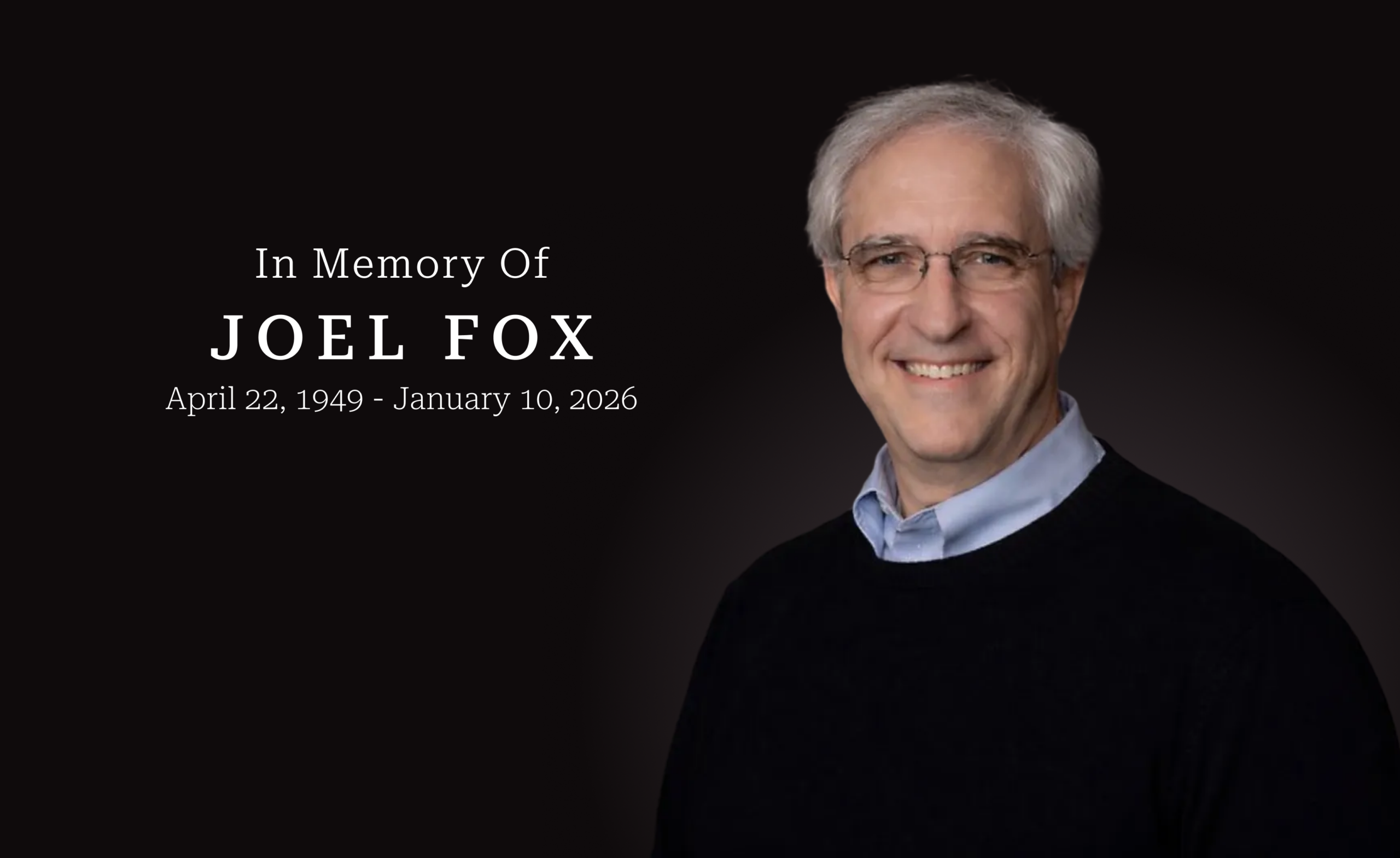
A Fox, A Hound, and a Friendship

If political differences are destined to leave us divided and friendless, how do you explain the life of Joel Fox?

Fox died on January 10 after more than a decade of living with cancer. He was California’s most prominent taxpayer advocate since Howard Jarvis, for whom he worked, and whose anti-tax organization he led from 1986 to 1998. Fox, a Republican, advanced conservative ideas on TV and op-ed pages. He advised the campaigns of Gov. Arnold Schwarzenegger, Mayor Richard Riordan, and U.S. Sen. John McCain.

That profile, in our polarized times, might make you think Fox was one of those political ideologues who are driving the country apart. But the opposite is true.

Fox, more than any person in California politics, built deep relationships with people across the political spectrum. And he did not do this through consensus or compromise. Instead, Fox built friendships on disagreement itself—a warm, open, and curious style of disagreement.
Read More »

Remodeling CA Tax Laws

Cross-posted at CalWatchdog.

During the gubernatorial campaign, job creation and retention was a prominent theme in candidate Jerry Brown’s speeches. And now as governor, his recent State of the State address also included the job theme. Since being elected in November, Brown has been pushing for creating green-energy and manufacturing jobs, investing in education and infrastructure, and improving job-training programs. But Brown is also calling for the extension of $14 billion in taxes, leading many to wonder how extending tax increases can help the state’s job creators.

California legislators spent much of the past year talking about the need to improve job-creating conditions, but with very different approaches, most preferring short-term “fixes” on budget problems, through tax and fee increases.

A recent analysis by the Tax Foundation of changes to state tax law in 2010 shows that of the states in the U. S. that raised taxes, the fixes were usually focused at specific groups, rather than enacting broad-based reforms. And the Tax Foundation analysis questioned Brown’s promise to pursue a ballot initiative in June that would increase the “temporary” taxes.

Read More »

The Tax Extension Election: Why it’s an Uphill Battle

The voters may have a simple way of resolving the state budget crisis: do away with state government. That’s a conclusion you can take from an unusual survey of opinions on government conducted for California Forward by Viewpoint Learning and released last week.

The survey looked at voter opinions of the various levels of government. Virtually without exception, respondents had more faith in local government to fix problems than state government. But neither level did particularly well. The survey asked how good a job STATE government was doing making California a good place to live: 21 percent said excellent or good; 75 percent said fair or poor. When asked about LOCAL government, the numbers were 36 percent excellent and good; 60 percent fair and poor.

When given 12 factors that kept state government from working well, too much “bureaucracy, waste and fraud” ranked first with 72 percent saying this was a big problem. It was followed by “political leaders don’t listen to regular people” (67 percent) and “elected officials aren’t held accountable for their action” (66 percent).

Read More »

Politics and the Inconvenient Facts

Last week, my colleagues and I released our latest analysis
of school expenditures in California (click
here for the study
), detailing the spending patterns in school districts
across the state.  As is often the case
when a piece of research strikes at the heart of a group’s political
agenda,  Peter Schrag’s column in the California
Progress Report
this week attacking that study is a classic example of
politics trying to divert attention from the inconvenient facts. 

When Peter contacted me last week, I spent the better part
of an hour explaining to him our methodology and the reasons why it was the
best approach to accurately reflect and describe the changes in school
expenditures in California.  While it is
clear he disagreed with our analysis, his response was not to engage in an open
debate over the major issues at the heart of our study, but rather to
regurgitate a politically-driven analysis of the study prepared by consultants paid
to spin the results to fit the agenda of the education establishment.

Read More »

Life Without Term Limits May Attract Bowen

You think it’s the weather?

For the second time in less than 18 months, one of California’s top elected officials is looking to jump ship in Sacramento in for the bright lights and freezing winters of Washington, D.C.

This time it’s Secretary of State Debra Bowen, whose political consultant told the Sacramento Bee that the veteran Democratic officeholder is “very, very seriously considering running for Congress” to replace Rep. Jane Harman.

When someone says “very” twice, you know it must be serious.

Harman, a centrist Democrat who is resigning to take over as president of Woodrow Wilson International Center for Scholars, represents the 36th Congressional District The Los Angeles district runs from San Pedro north to Marina del Rey, which Bowen represented as an assemblywoman and state senator.

Read More »

A smart regulatory-making process will generate California revenue

Last week we heard about California’s budget crisis in Gov. Jerry Brown’s 20-minute State of the State address.

While Gov Brown stuck to state budget details in a brief 20-minute address, the regulatory crisis movement is gaining momentum as a realistic solution to revenue shortfalls here and across the country.

For example:

Read More »

Playing Chess with Election Dates

Initiative proponents and consultants often calculate in which election they would like their ballot measures to appear. So when I heard that a bill in the California legislature would eliminate the February California presidential primary for 2012, I wondered if a little politics was at play.

The bill’s author, Assemblyman Paul Fong (D-Cupertino), insists that the reason for eliminating the February primary and joining the presidential primary to the primaries of state officials in June is a cost saving measure. Keeping the February presidential primary would make three statewide elections in 2012. And, this after a possible special election this summer, supposedly a non-election year.

However, in initiative-mad California, eliminating a potential election day can change the strategy for certain ballot measure proponents who, like grand master chess players, often make their move to file an initiative depending on which election the proposition will appear.

Other states are looking to get rid of early primaries that were created last presidential cycle so the states would have a relevant role in nominating presidential candidates. The Los Angeles Times’ Mark Z. Barabak yesterday had a good synopsis of the potential changes coming for the 2012 presidential primaries.

Read More »

Brown’s California Budget Proposals: a Big Step in the Right Direction

Cross-posted at NewGeography.

I admit it. I had low expectations for Jerry Brown’s third term as governor. After seeing his budget proposal, I’m ready to reconsider my expectations. I think it is a great effort, and it deserves the support of all of us tired of seeing our state reduced to laughing stock.

Being an economist, I first went to the Economic Outlook section of the Proposed Budget Summary. This is where governors put in rosy expectations and forecasts, thus enabling a multitude of fiscal sins. I was shocked to find a realistic and sober economic analysis. In fact the U.S. and California GDP projections were lower than ours, and we are among the least optimistic forecasters in America. There is no smoke here. There are no mirrors. It is apparent to me that if Brown is to be surprised, he only wants good ones.

This may be the most honest forecast accompanying a proposed budget that Californian’s have seen in decades.

The realistic economic forecast leads, reasonably, to lower budget revenue assumptions, lower by billions of dollars. With more realistic revenue assumptions, Brown forecasts a larger budget problem than did his more easily deluded predecessor.

Read More »

Internet tax budget gimmick will lose the state revenue

When
Assemblywoman Nancy Skinner stood on the steps of the Capitol to announce her
online sales tax legislation, it was no surprise to see the usual suspects dead
set against spending reductions backing her up. But the reality is that
California has a $25 billion overspending addition to solve, and contrary to
Skinner’s claims, her Internet tax budget gimmick will actually lose the state
revenue by putting thousands of Californians out of business.

Skinner
claims her Internet tax proposal – which attempts to force out-of-state online
retailers to collect tax on California sales – will bring in $300 million. That
happens to be double the amount a Board of Equalization report concluded, and
its claims are also questionable.

U.S.
Supreme Court law says California can’t force a retailer to collect tax unless
they are located in the state. Skinner’s bill tries to get around this by
assuming a retailer has a presence in California if they merely advertise
through an in-state affiliate. The reality is, it’s a scheme unlikely to pass
legal or practical muster: to avoid collecting Skinner’s unconstitutional tax,
online retailers will end advertising contracts, putting 25,000 individuals and
small businesses in California out-of-business. This is precisely what happened
in Rhode Island and North Carolina when identical laws were passed.

Read More »

Discussing Reagan’s Legacy

We are living in the age of Reagan said presidential historian Douglas Brinkley at a panel discussing Ronald Reagan’s legacy Wednesday at the Ronald Reagan Presidential Library.

Richard Reeves, author and historian, was more succinct. “Ronald Reagan is still president,” he said, meaning the country is living with a political philosophy set out by Reagan. In the same way, Reeves continued, Franklin Roosevelt was president for 30 years.

Reeves said Reagan changed American politics by reversing the populist political attitude of one that believed business was the villain to making government the adversary. Reeves called this an “incredible political achievement”

As part of the celebration of Ronald Reagan’s 100th birthday on February 6, the Ronald Reagan Presidential Foundation has partnered with four universities around the country to examine the life and times of the 40th president. The first session was coordinated with USC’s School of Policy, Planning and Development.

Read More »