
Featured Post

A Fox, A Hound, and a Friendship

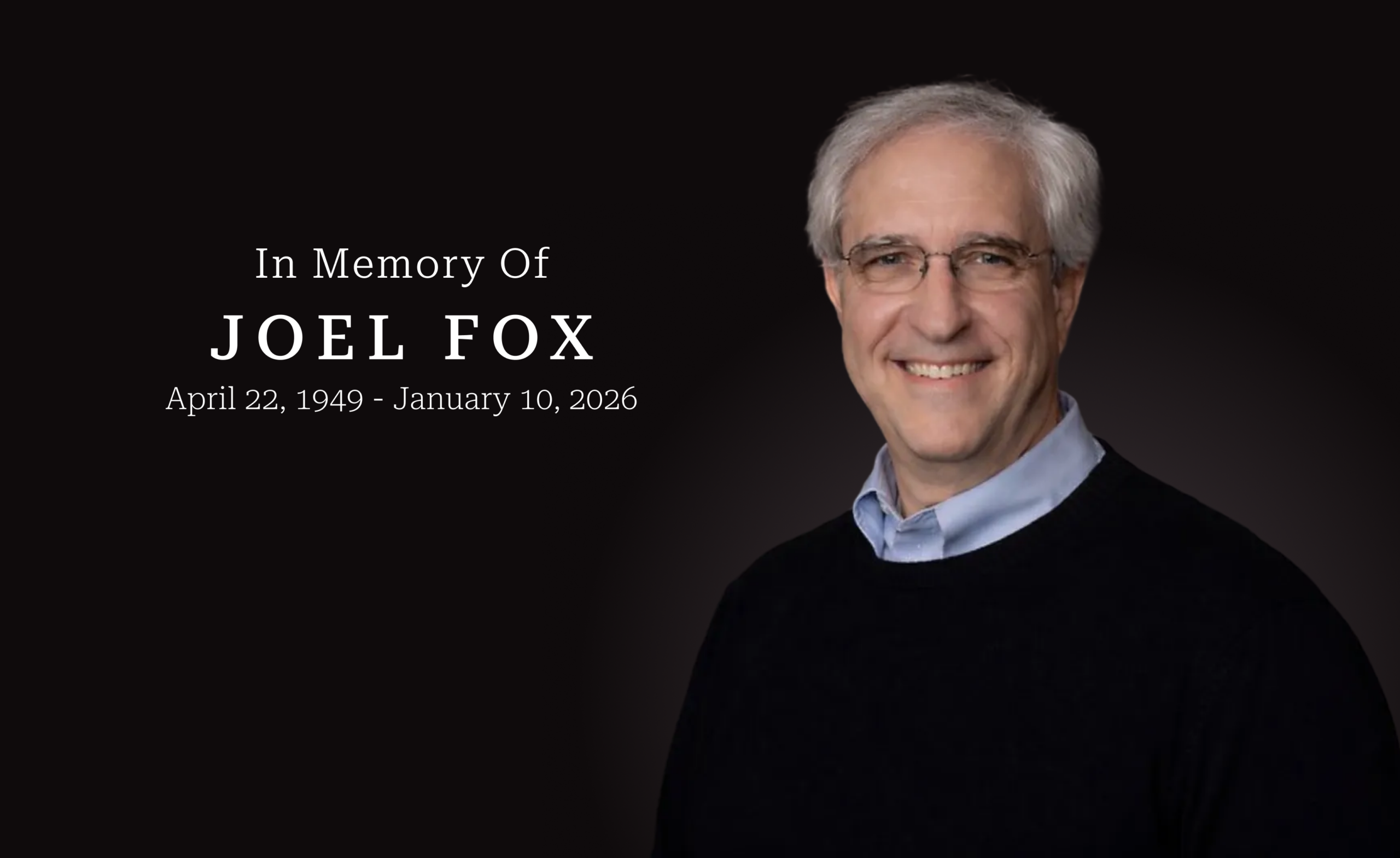
If political differences are destined to leave us divided and friendless, how do you explain the life of Joel Fox?

Fox died on January 10 after more than a decade of living with cancer. He was California’s most prominent taxpayer advocate since Howard Jarvis, for whom he worked, and whose anti-tax organization he led from 1986 to 1998. Fox, a Republican, advanced conservative ideas on TV and op-ed pages. He advised the campaigns of Gov. Arnold Schwarzenegger, Mayor Richard Riordan, and U.S. Sen. John McCain.

That profile, in our polarized times, might make you think Fox was one of those political ideologues who are driving the country apart. But the opposite is true.

Fox, more than any person in California politics, built deep relationships with people across the political spectrum. And he did not do this through consensus or compromise. Instead, Fox built friendships on disagreement itself—a warm, open, and curious style of disagreement.

Read More »

The Perils Of Prop 15

Hidden away on the June primary ballot is Proposition 15, titled the California Fair Elections Act.  While the measure has not received a lot so attention so far, it is a classic example of the law of unintended consequences.  

Disclosure: I am one of the ballot pamphlet signatories opposing this measure.  I signed the rebuttal argument for a couple of reasons.  This is a system of public financing of elections placed on the ballot by the legislature, ostensibly to test public financing in the Secretary of State’s election, beginning in 2014. 

However, the authors conveniently forgot to tell the voters that hidden away in the measure is language repealing the currently existing prohibition on public funding of political campaigns.  It took a lawsuit to get this fact onto the ballot label.

Read More »

Poizner Poll Shows Race Closing

Steve Poizner’s campaign released an internal poll showing Poizner closing to 10 points behind Meg Whitman in the Republican gubernatorial primary setting off dueling press conferences between the campaigns to discuss the meaning of the poll.

Poizner’s people emphasized momentum; Whitman’s people talked electability.

Let us talk about a wild ride until Election Day for those who revel in political horse races.

Read More »

Green Economy Is Proven Job Creator

James Kellogg’s recent piece "True Impact on Working People of AB 32 is No
Mere Numbers Game
" seeks answers about the impact recent environmental
legislation will have on jobs in California but unfortunately leaps to
doomsday conclusions that good paying jobs in the trades will vanish
from our state as we move to a cleaner, more energy independent
economy. Nothing could be further from the truth.

Employment in the core green economy in California is now larger than
the state’s robust biotech industry. Between 1995 and 2008 employment
in the green economy grew by 36 compared to 13 percent for the overall
economy, according to an analysis by Collaborative Economics.

Even
through the recession this sector expanded as others contracted. Why
would we now turn our backs on part of the economy that is creating
jobs and in 2008 attracted $3.4 billion in venture capital, nearly six
times more than the next leading state?

Read More »

Poizner and Whitman Battle for the Old In a War Both Are Losing

Wednesday was a busy day for spin in the governor’s race. Cut through all the talk about polls and general election viability, and two things stand out.

1. Whitman and Poizner are both losing.

Losing in the sense that each is unpopular – and becoming more so. Whitman strategist Mike Murphy and his Poizner counterpart Stu Stevens each did an effective job of explaining the problems of his candidate’s opponent. Murphy made a convincing case that Poizner’s move right in the primary would cost him badly against Jerry Brown in a general election. Stevens was convincing in describing Whitman’s strategic missteps and vulnerabilities as a CEO candidate who wasn’t engaged in political and civic life until recently.

Read More »

Slow Down and Revise AB 32

At times, even the best of us need to stand down, take a deep breath, and head back to the drawing board. That need to reassess happens in business when the market changes, in our jobs when the company downsizes, or in our lives when unexpected situations arise. We have unquestionably reached that point where the state needs to reassess the AB 32 Scoping Plan and find a solution that will balance the need to reduce greenhouse gas emissions with the ability of the state’s economic system to absorb the changes.

Perhaps the problem with the current process is that we are demanding
too much from the California’s Air Resources Board (CARB).  Rather than
asking an environmental regulatory agency to consider macro-economic
factors involving employment, industrial growth, and world trade, the
state should tap additional resources to weave together a plan that
will preserve our current jobs while we develop new technologies for
the future.

Almost every study on the CARB plan has revealed an economic impact,
but the controversy arises over two major areas.  First, there is
disagreement over the degree of impact – some studies find significant
economic ramifications while other reports show minimal effects on
consumers and business.  Second, the studies vary regarding the degree
to which costs will be offset by the benefits that may come with growth
of new technologies. 

Read More »

Redevelopment Decision Necessary Stopgap Measure

On top of the news that state revenue is falling short of what was anticipated by $3 billion, comes the decision from Superior Court Judge (and former state legislator) Lloyd Connelly that the state can shift $2 billion in local redevelopment funds to schools.

Redevelopment agencies will appeal the decision. But, if nothing else, Judge Connelly’s decision will force a hard look at the effectiveness and oversight of the redevelopment process and that is a good thing. 

By declaring "blight" in communities, redevelopment agencies can use the power of eminent domain to seize property and develop the blighted areas while attaching the "tax increment" revenue to the redevelopment agency. The "tax increment" is the new property tax revenue that is the amount of taxes above what the property was paying when it was "blighted." The new revenue stays with the redevelopment agency and is not available for schools and other county government services.

Read More »

No Surprise In State Tax Returns

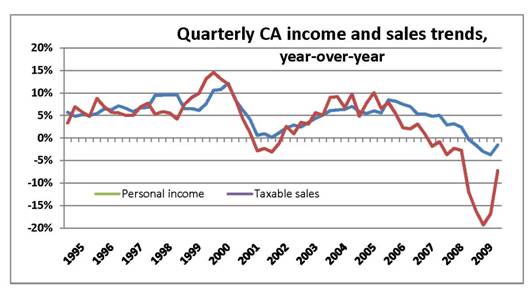
The April surprise in state tax returns
this year should be no surprise – except to those who crave the fantasy
of painless solutions over the economic reality of every day
California.

After all, what in the personal income and retail sales
numbers could have spurred this unwarranted optimism?

Read More »

California is Too Big To Fail; Therefore, It Will Fail

Cross-posted at NewGeography.com

Back in December I wrote a piece
where I stated that California was likely to default on its
obligations. Let’s say the state’s leaders were less than pleased.
California Treasurer Bill Lockyer’s office asserted that I knew
"nothing about California bonds, or the risk the State will default on
its payments." My assessment, they asserted, "is nothing more than
irresponsible fear-mongering with no basis in reality, only roots in
ignorance. Since it issued its first bond, California has never, not
once, defaulted on a bond payment."

Read More »

True Impact on Working People of AB 32 is No Mere Numbers Game

It’s time for an honest discussion about how California’s global warming law (AB 32) will impact jobs in California. Working people in this state are suffering and they need real answers about its job impact, not theories, legacy politics and empty promises.

Consider a few grim statistics: The state’s unemployment rate is still above 12 percent.

More than 119,000 manufacturing jobs were lost last year. More than 600,000
manufacturing jobs have been lost in this state since 2000. Blue collar workers in the
building trades have been particularly hard hit, with unemployment rates at some local
unions as high at 30 percent to 40 percent.

Read More »